

The start of a new year carries a lot of promise and excitement. Fresh calendars. Big intentions. A collective sense of this is the year things change.
And then… life happens.
Routines get disrupted. Motivation fades. The habits we swore we’d keep quietly slip away. When that happens, it’s easy to pile on guilt or tell ourselves we’ve failed.
But that’s just not the case. It simply means you’re human. Shame will never help us move forward. We just need permission to start where we are — whenever that happens to be.
A Tool I Return To Again and Again
One of the tools I revisit most years is called Level 10 Life.
This year, for a variety of reasons, I didn’t sit down with it in January. And instead of deciding I’d “missed my chance,” I reminded myself of something important: You don’t need a new year. Or a Monday. Or a clean slate. You can start on a random Wednesday in March.
Level 10 Life is a simple and powerful way to take an honest look at your life as a whole — not to judge it, but to understand it. I was introduced to this concept over a decade ago when I read The Miracle Morning by Hal Elrod. The book is best known for establishing morning routines, but this framework stood out to me because it brings clarity and focus (and I get to color-code everything).
What Is Level 10 Life?
At its core, Level 10 Life helps you evaluate ten major areas of your life and see, visually and intuitively, where you feel fulfilled and where you might want to grow.
The traditional categories suggested by Elrod include:
- Health & Fitness – physical health, energy, mental and emotional well-being
- Family & Friends – connection, support, and quality of relationships
- Romantic Relationship – partnership, communication, intimacy
- Personal Development – learning, growth, self-trust, emotional maturity
- Career – fulfillment, alignment, progress, satisfaction
- Finances – stability, freedom, habits, relationship with money
- Physical Environment – your home, workspace, and how supported you feel by your surroundings
- Giving & Contribution – service, generosity, impact beyond yourself
- Fun & Recreation – play, rest, creativity, enjoyment
- Spirituality – inner peace and connection to something greater (defined however you choose)
You’re not locked into these categories. You can rename them, swap them, or redefine them entirely. The goal isn’t to fit into a rigid system — it’s to create a system that reflects your life.
Step 1: Define Your “10”
Before you rate anything, pause and ask yourself:
What would a 10 actually look like for me, in this season of my life?
This part matters more than people realize.
A “10” doesn’t have to mean perfection. It doesn’t mean someone else’s version of success. It means your version of deeply satisfying, sustainable, and aligned living.
For example:
- A 10 in health might mean consistent energy and strength — not a certain weight.
- A 10 in finances might mean stability and predictability — not wealth.
- A 10 in spirituality might mean daily grounding — not church attendance.
Define your 10s with honesty and compassion.
Step 2: Rate Yourself (Gently)
Once you know what a 10 looks like, rate yourself in each category from 1–10.
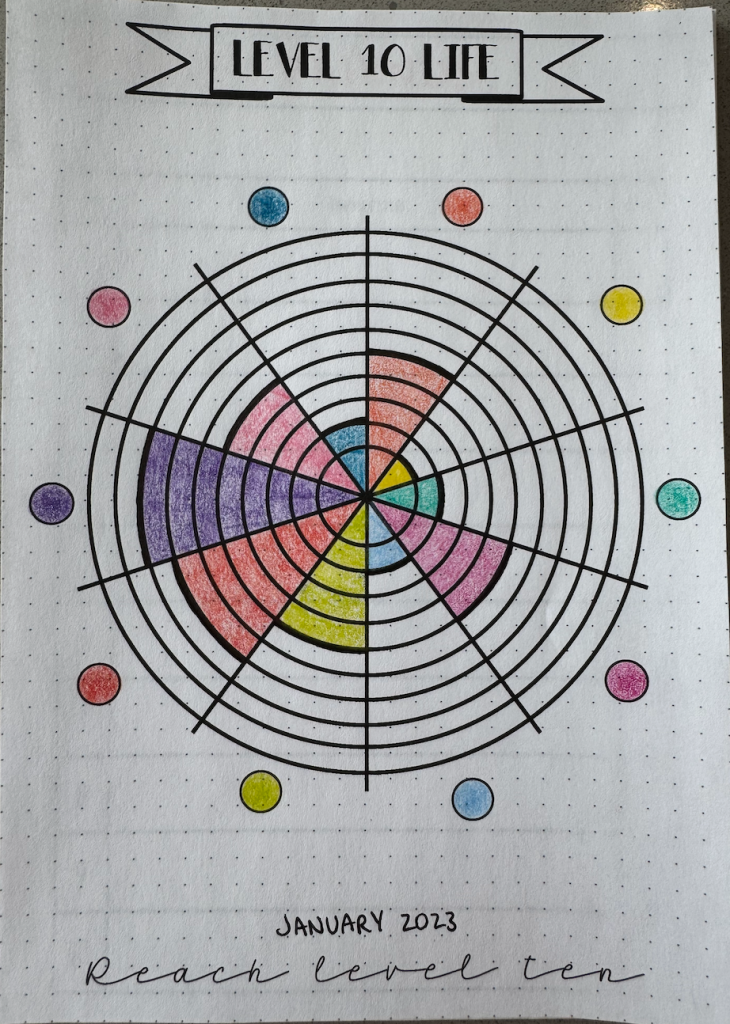
Don’t overthink this. Go with your first instinct. If your health feels like a 4 and your spirituality feels like a 9, that’s not good or bad. It’s just information. The goal is objectivity, not self-criticism. These numbers aren’t a measure of your worth. They’re simply a snapshot of where your energy, attention, and care are currently being focused. Below is an example** of my 10 categories and ratings from 2023 (color-coded, of course).
Step 3: Choose Intentional Goals
After you’ve rated each area, you get to decide what you want to work on. This is where people sometimes make it harder than it needs to be. You don’t need goals for every category. You don’t need aggressive timelines. You don’t need to fix everything all at once.
You might choose:
- One small habit
- One long-term vision
- One area to simply maintain
Your lowest score isn’t automatically your starting point. Sometimes the “lowest” area is a long-term project, and the best first move is the category that will create momentum. I like to ask: Which area, if I raised it by just one point, would make everything else feel easier?
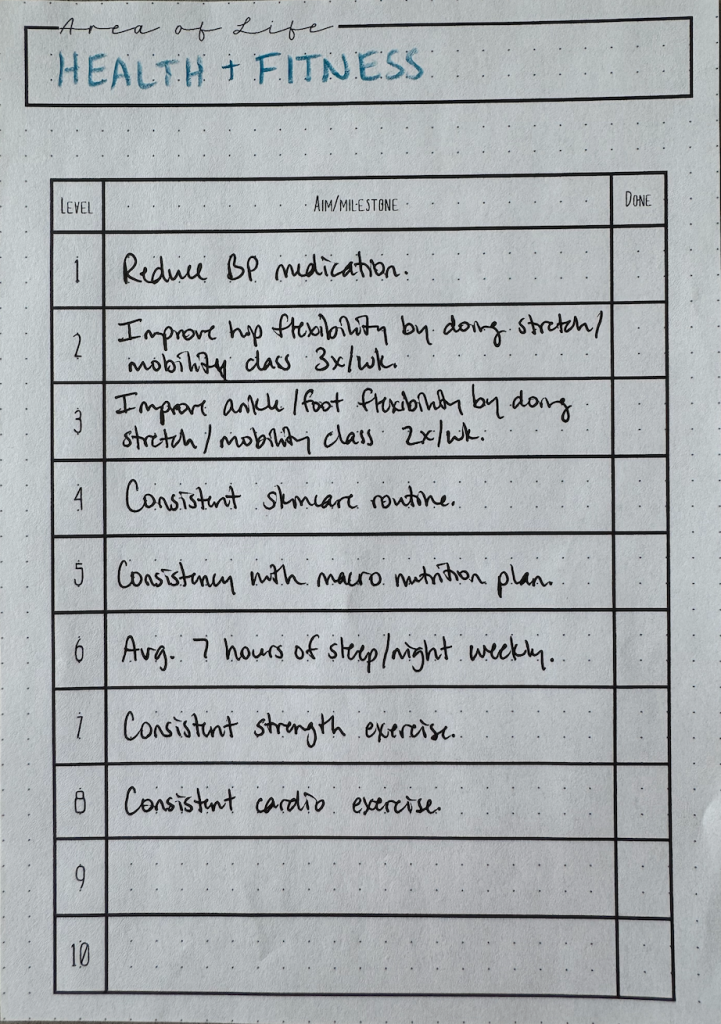
In 2023, my health and fitness category** included eight goals, although I knew full well I wouldn’t complete them all that year. And that was okay. Some goals are seeds. Some take years. Level 10 Life isn’t about pressure — it’s about direction.
Step 4: Revisit, Reflect, Adjust
One of my favorite parts of this process is looking back at previous years. It’s interesting to see:
- Goals I once thought were urgent
- Goals I’m still working toward
- Areas that have quietly grown without me noticing
It reminds me that growth is rarely linear — and that keeping agreements with yourself matters more than speed. You can revisit your Level 10 Life quarterly, yearly, or anytime you feel disconnected. There’s no “right” cadence.
Common Mistakes (and Gentle Course Corrections)
Like any reflective tool, Level 10 Life works best when it’s used with honesty and flexibility. A few common pitfalls to be aware of:
1. Trying to improve everything at the same time
It’s tempting to look at your wheel and want to raise every number immediately. But real change rarely happens that way. Choosing one or two areas to focus on is far more effective than spreading yourself thin.
2. Defining a “10” based on someone else’s life
If your definition of a 10 comes from social media, family expectations, or who you think you should be, this will feel discouraging instead of supportive. Your 10 should reflect your values, your season, and your capacity, not an idealized version of life.
3. Using the ratings as a judgment instead of information
A low number isn’t a failure. It’s a signal. The purpose isn’t to label areas of your life as “bad,” but to notice where care, attention, or boundaries might be needed.
4. Treating it as a one-time exercise
Level 10 Life isn’t meant to be completed once and forgotten. Life changes. You change. Revisiting it periodically allows the tool to evolve with you — and helps you see growth you might otherwise miss.
5. Turning goals into pressure
Goals are meant to guide, not shame. If a goal no longer fits, you’re allowed to adjust it. Keeping agreements with yourself sometimes means renegotiating them honestly, or throwing them out altogether.
Why This Works
Level 10 Life works because it brings awareness without overwhelm. It doesn’t demand perfection. It doesn’t shame stagnation. It simply asks you to pay attention — and choose intentionally.
If that sounds like something that could support you, I’ve linked a similar printable version to the format I use below, created by the same company, ScatteredPrintables. Start where you are. Choose one thing. Let it be enough.
One step at a time,
Ila
**You can find a similar digital download from the same company here. It appears the exact version shown above is no longer available.
*Stay tuned next week for a deeper dive into setting goals with this system.
1 thought on “Level 10 Life”
I’ve made list similar to this listing things to do to better myself for some reason I never seemed to be able to stick to them. I’ve been trying to work on myself for that reason also quit starting things and quit quitting..